Holding the Innovation Ace, Advancing with Light
China's Optical Fiber and Cable Industry Ranks among the World's Top Tier
CCTV News: During the 14th Five-Year Plan period, China built the world’s largest information and communications network with globally leading technology. The number of 5G base stations reached 4.598 million, and network capabilities entered the “dual-gigabit” era. Behind this vast network infrastructure, optical fibers serve as vital carriers for high-speed information transmission. In Optics Valley in Wuhan, Hubei Province, a company specializing in optical fiber and cable production has spent the past five years pursuing independent technological innovation and seizing the opportunities of the times.
Company executive Zhuang Dan explained that a transparent, high-purity preform about 23 centimeters in diameter is processed through fiber drawing and other procedures into an optical fiber only slightly thicker than a human hair. A single such fiber can simultaneously accommodate the voice communication needs of all 8 billion people worldwide.
Zhuang Dan said that the equipment has been comprehensively innovated in-house and that the company's optical fiber drawing cost is, in his words, absolutely the lowest in the world. He added that the progress made during the 14th Five-Year Plan period has brought people a strong sense of tangible benefit.
The preform is the most technologically sophisticated link in the optical fiber industry chain. With advantages in both technology and cost, China's optical fiber and cable industry achieved leapfrog growth during the 14th Five-Year Plan period and entered the world's top tier.
Zhuang Dan said that this preform was developed through the company's own R&D during the 14th Five-Year Plan period. It is now also the largest of its kind in the world and can be drawn into nearly 10,000 kilometers of optical fiber, all made possible through independent innovation.
Zhuang Dan said that, from the perspective of building China into a “network powerhouse,” a very important foundation has been the sustained investment in broadband, optical fiber and 5G, which has provided strong momentum for the company. Demand for optical fiber has continued to rise over the past five years. In terms of building a “manufacturing powerhouse,” the company was also included in the first national batch of Excellent-Level Smart Manufacturing Factories in January 2025. Riding the tailwind of national policies and strategies, YOFC has been able to develop strongly.
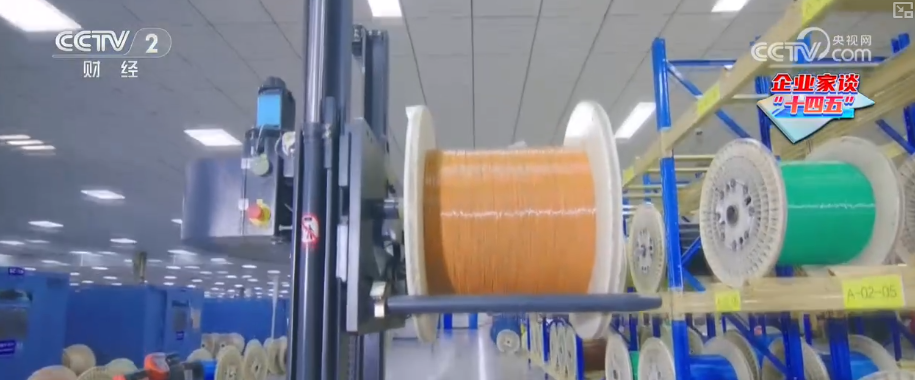
Turning to intelligent manufacturing, Zhuang Dan took the reporter back into the workshop. On a large screen, the operating status of every fiber-drawing tower could be seen at a glance.
Zhuang Dan explained that during the 14th Five-Year Plan period, the company created digital twins for its equipment and invested hundreds of millions of yuan each year in digital transformation. Going forward, it aims to continue moving toward fully unmanned factories.
The company's development has not always been smooth. Zhuang Dan said that domestic communications infrastructure construction once entered a temporary plateau. At its peak, annual growth in business demand exceeded 25%; at its lowest, growth turned negative. Yet even during the most difficult periods, he remained committed to increasing investment in technological innovation.
Zhuang Dan said that in recent years the company has set a clear policy of spending no less than 5% of sales revenue on R&D. In 2024, it devoted 6.5% of sales revenue--nearly RMB 800 million--to R&D, following a technology strategy of “commercializing one generation, reserving one generation and pre-researching one generation.” As AI drove explosive growth in new markets, the company seized a major opportunity. Optical communications products for data center connectivity, as well as backbone network upgrades by telecom operators, also require a new type of optical fiber.
Hollow-core fiber is a new direction in which YOFC has achieved a technological breakthrough over the past two years.
Zhuang Dan explained that conventional optical fiber has a solid core, whereas hollow-core fiber contains a near-vacuum interior, resulting in extremely low attenuation and very high transmission speeds. By analogy, hollow-core fiber is like a “maglev train,” with transmission speeds about 50% higher than those of solid-core fiber.
During the 14th Five-Year Plan period, the country actively encouraged and supported companies in “going global” and expanding into overseas markets. In Zhuang Dan's view, internationalization has been a key means of breaking through development bottlenecks. Today, the company has established eight production bases across six countries overseas, and overseas revenue rose to more than 40% of total revenue in the first half of 2025.
Zhuang Dan said perceptions of Chinese manufacturing overseas have changed dramatically. Two or three years ago, the company acquired a business in Brazil. The optical cable manufacturing equipment now supplied there is designed and assembled entirely by YOFC. The Brazilian company was deeply impressed, as the new equipment significantly improved efficiency compared with what it had used before. In the past, Chinese manufacturing was often associated with mid-to-low-end products; today, Chinese manufacturing equipment is highly welcomed in overseas markets.
At present, Wuhan Optics Valley, where YOFC is based, is accelerating the development of a world-class advanced optoelectronic information manufacturing cluster with an output value of one trillion yuan. Looking ahead to the next five years, Zhuang Dan is also targeting multiple industries related to “light” technologies, with diversified development expected to create greater opportunities for the company.
Source: CCTV